
Knockout vs Round-Robin Snooker Tournaments: Which Format Fits Your Club?
Compare match counts, player experience and scheduling before choosing an event structure.
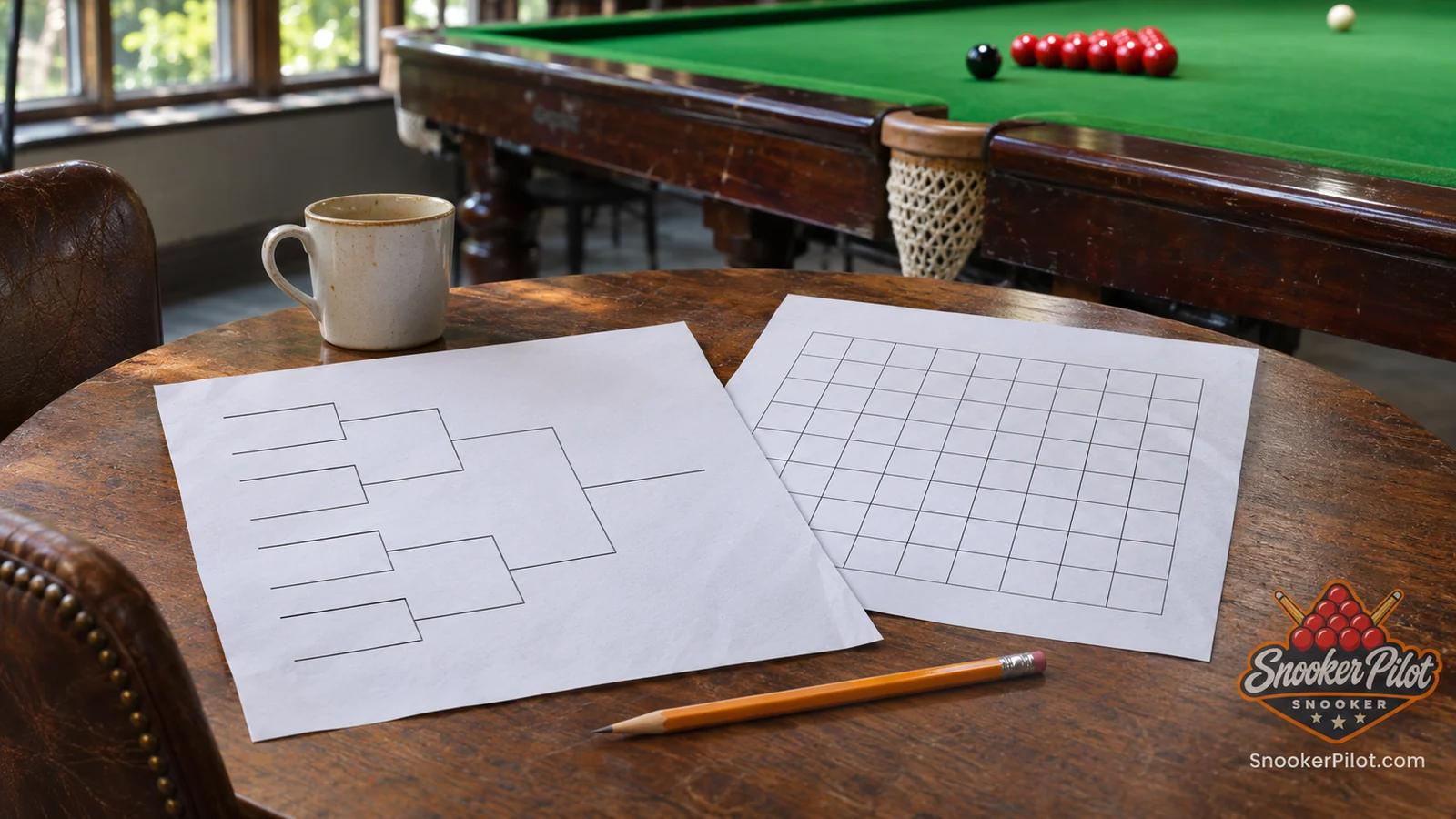
Count matches before drawing names
A straight knockout with eight players needs seven matches: four quarter-finals, two semi-finals and a final. A single round-robin with eight players needs 8 × 7 ÷ 2 = 28 matches because every pair meets once. That difference matters far more than the appearance of the draw. Multiply by your chosen match length and allow for table changes before announcing a finish time.
Choose the experience you want
Knockout gives a clear progression and lower total demand, but an entrant may lose once and be finished. Round-robin gives more guaranteed opponents and can suit a social learning event, at the cost of much more table time. Group standings also need published tie-breaks. Do not decide those only after two players finish with the same record.
How Long Does a Snooker Match Last? Frames and Match Formats Explained
Consider a small group stage
Two groups of four require six matches per group, 12 altogether. Adding two semi-finals and a final brings the total to 15. This offers multiple group games without the full 28-match schedule, but still takes more capacity than seven-match knockout. Publish advancement, points and tie-break order, and check whether simultaneous final group matches are practical for fairness.
Match the tools to the format
A generic score display is not automatically a group scheduler. Before entries open, confirm whether your chosen system creates fixtures, computes standings and applies your tie-breaks. If those tasks are manual, assign an owner and keep one authoritative sheet. Avoid promising automation merely because the product has a tournament button.
At your club with SnookerPilot
SnookerPilot’s current tournament workflow is knockout, available on Club and higher, with 2, 4, 8, 16 or 32 players. It does not automatically schedule round-robin groups or calculate their standings. You can use ordinary scoring for separately organized group games, then run a supported knockout stage, while keeping the group administration explicit.
Compare the packages